You would never expose a REST API without an API gateway in front of it. Authentication, rate limiting, observability, access control — these aren’t optional extras. They’re mandatory, and we’ve spent the last decade building the API gateway pattern to solve exactly this problem.
So here’s the question worth sitting with: would you expose Kafka or any event stream without a gateway?
To answer that, we first need to define the event gateway: A Kafka event gateway is a dedicated infrastructure layer that sits between your Kafka brokers and external or internal consumers, providing security, protocol translation, and centralized governance without exposing your underlying event streaming architecture.
First, what is an event?
Before we talk about an event gateway, it’s worth grounding ourselves on what an event is.
An event is simply a record of something that happened.
In modern integration, there are two main ways to connect systems.
- A synchronous request-response port — an application asks for information, makes a request, and waits for an answer. A large portion of the internet works this way, whether it’s REST, GraphQL, or MCP tool calls.
- An asynchronous event port — an application produces or consumes events. A user logging in. A product added to a cart. A sensor reading from a factory floor. Events are the things accumulating in your system over time.
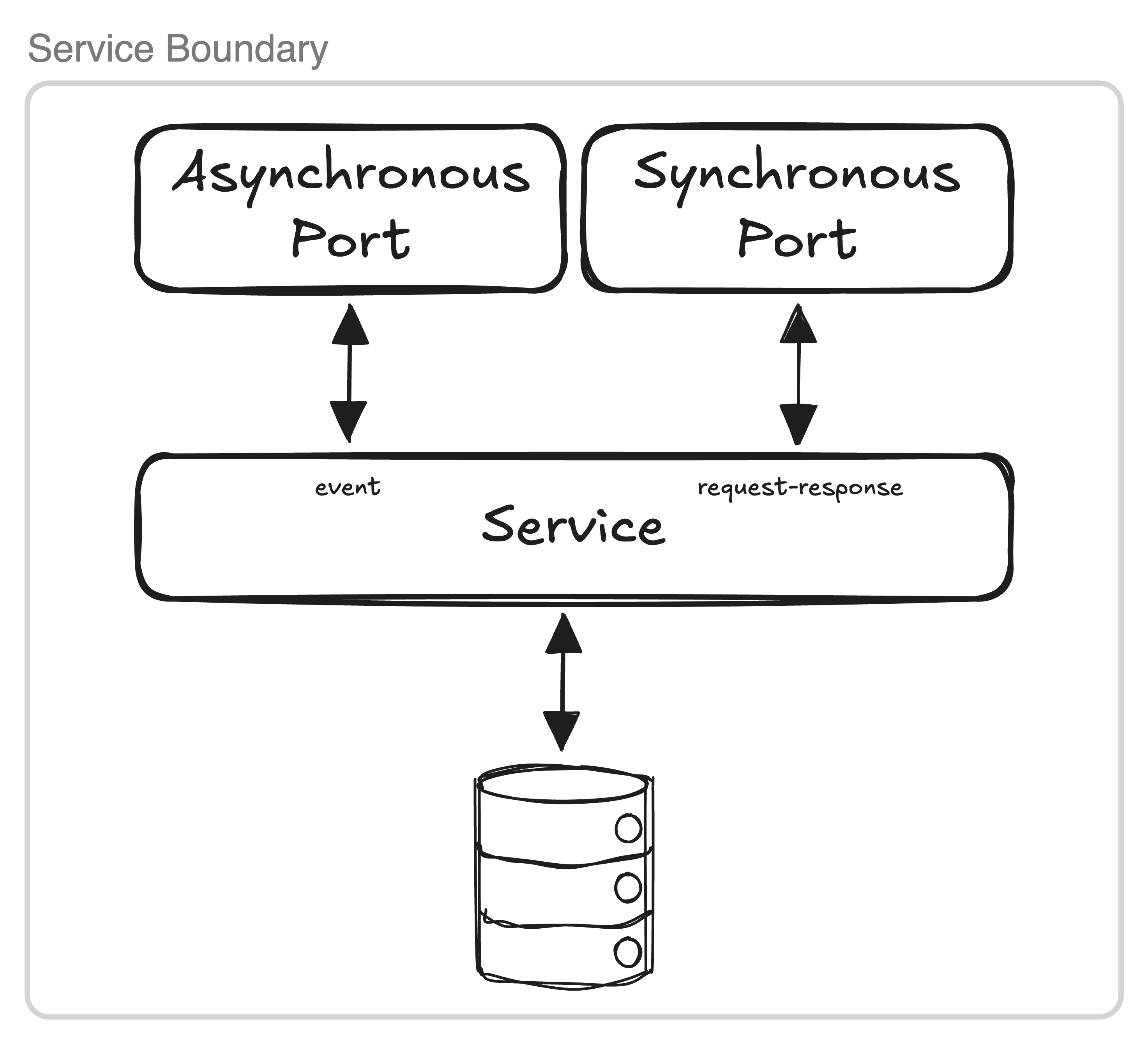
Dual Port Integration
The tool most commonly used to store and serve these events is Apache Kafka. Its core data structure is simple: an append-only log. You never overwrite data — you just keep accumulating what happened, so any number of services can consume and react to them.
For years, we’ve treated the synchronous port as the primary external integration port and the asynchronous port as an internal implementation detail — something that moves data between your own services, not something you safely expose to the outside world. That assumption is starting to change, and the emergence of event gateways is accelerating this shift.
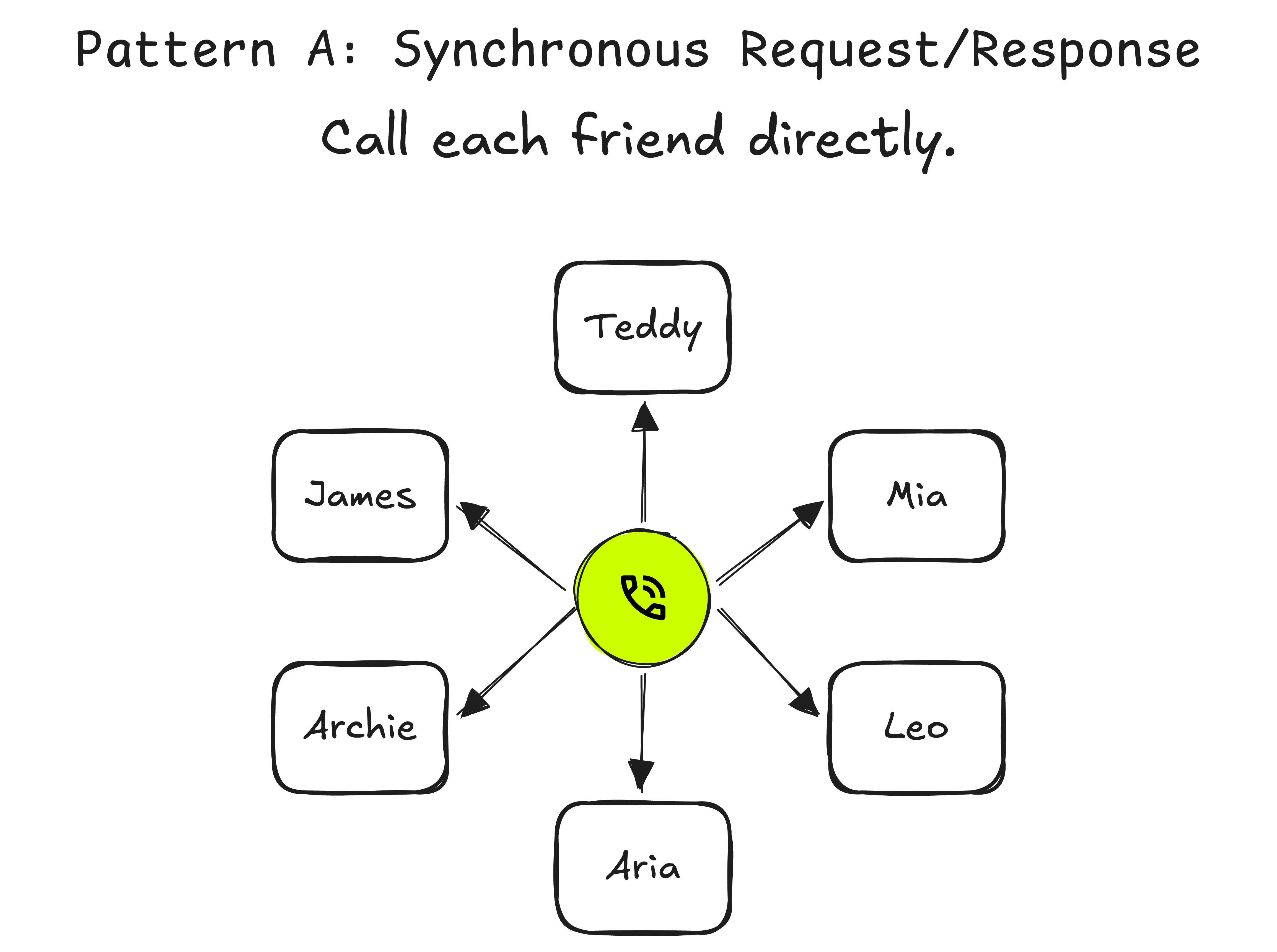
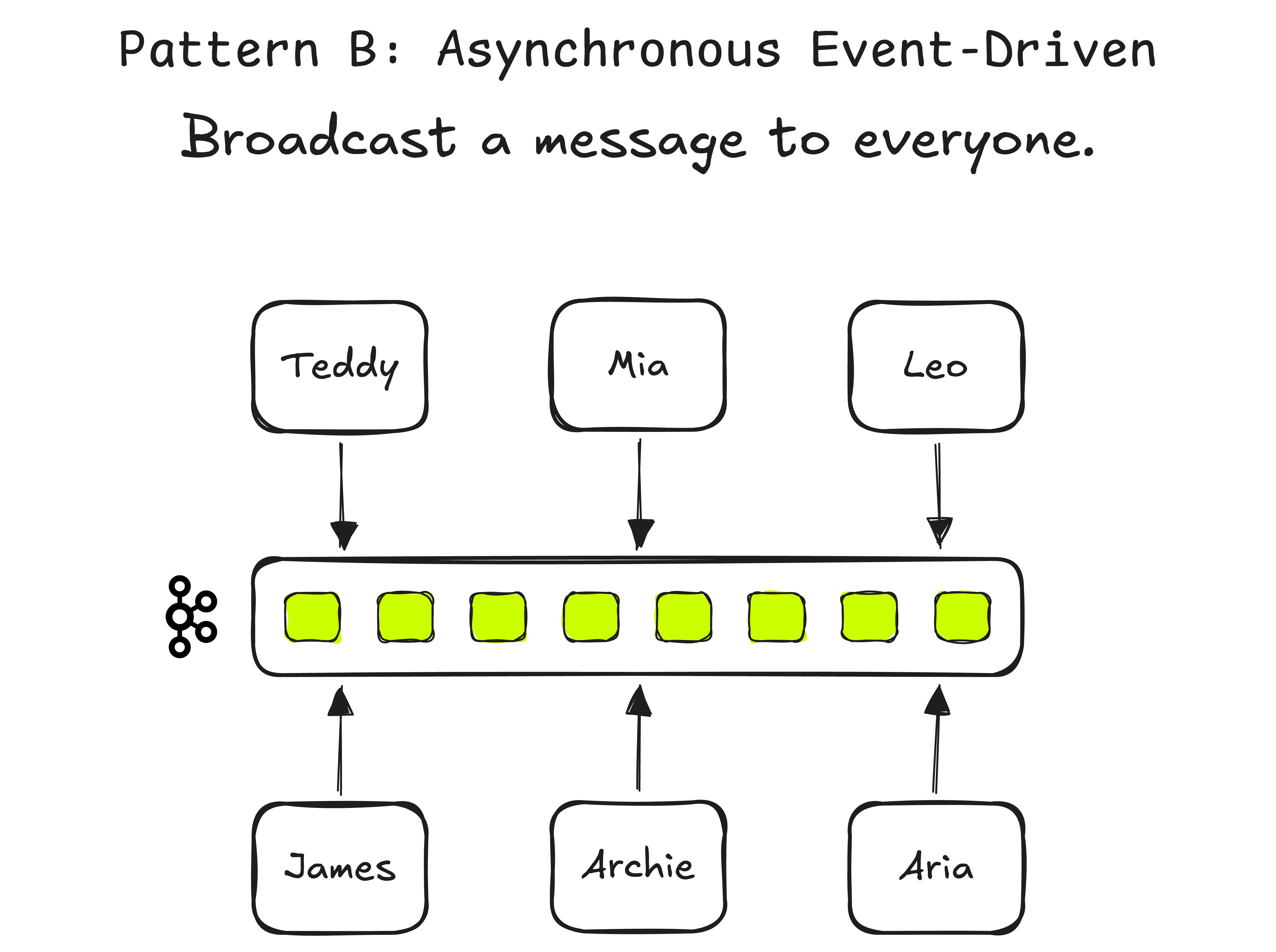
The birthday party: Synchronous vs asynchronous integration examples
My daughter recently turned one. If you’ve ever organised a first birthday party, you quickly realize it’s somehow more stressful than organising a wedding. There are invitations, a venue, RSVPs, a cake, food, invoices, weather monitoring, and guest notifications — to name a few. One of the very first things I had to do was invite all her friends. So I had two options:
- Option 1 — synchronous: We can call every friend individually. I pick up the phone, wait for them to answer, invite them, and receive their RSVP. You get an immediate, confirmed answer. But everyone has to be available at the exact moment you’re calling, and if your daughter has as many friends as mine does, you’ll be on the phone for days.
- Option 2 — asynchronous: We can post a message in a group chat. We announce the date and venue once, and let people respond in their own time. Some people may RSVP within minutes. Someone else may come back three days later. The information is there when they’re ready for it.
So which option do you choose? It depends — and that’s exactly the point. The right approach is always dependent on the context. The problem is that most systems have defaulted to synchronous even when asynchronous may be a better fit.
Reactive AI agents demand events
We already expect the systems we use every day to be reactive. When you book a venue, a confirmation email arrives immediately. When you pay an invoice, the transaction appears in your bank account within seconds. These experiences are all driven by events that are happening in the system. They are event-driven.
And the expectation of reactive systems is only growing — especially as our industry shifts from deterministic applications to AI agents. Agents can’t sit there polling for updates every minute or wake up at 1 a.m. to run a batch job.
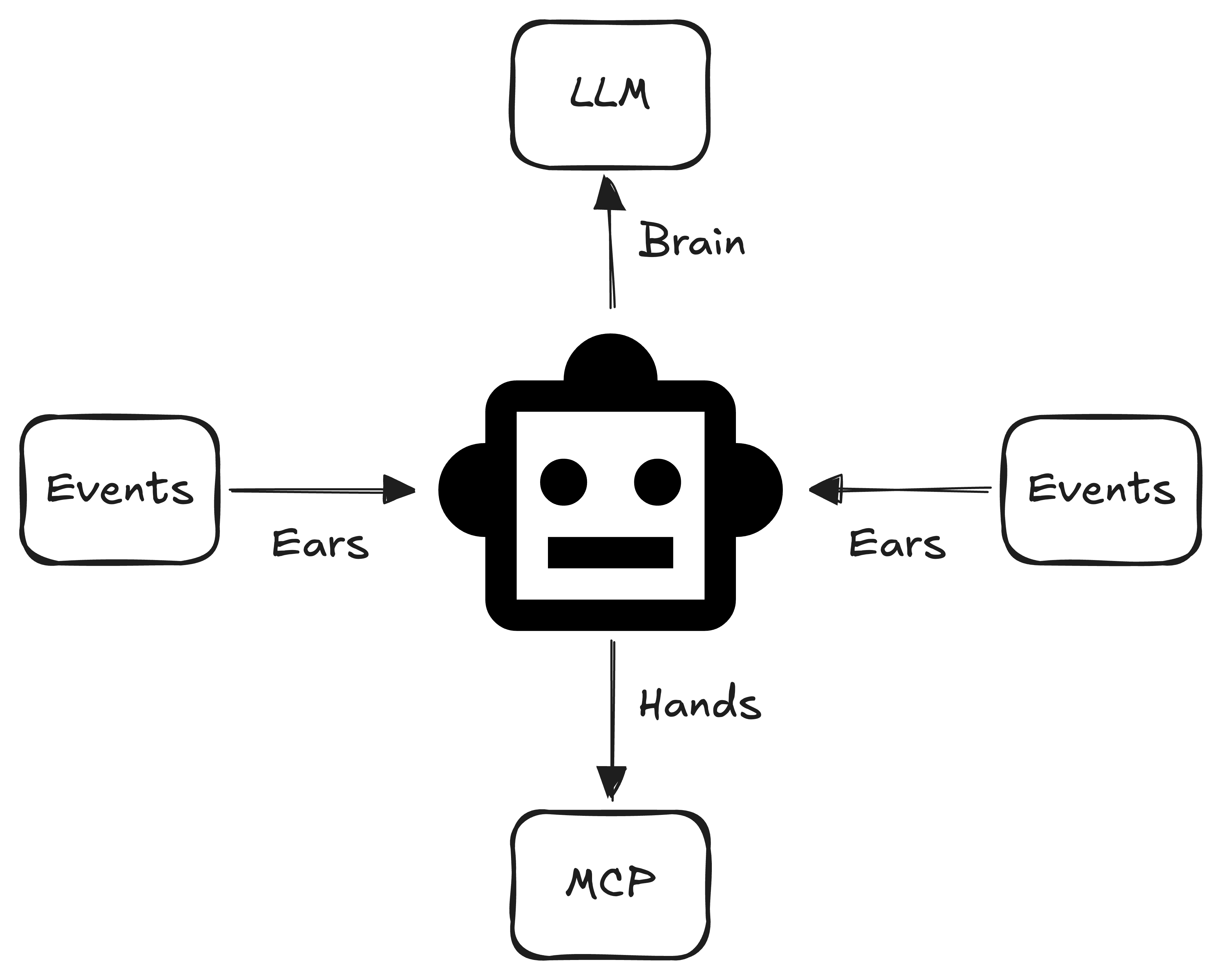
Just as humans are constantly listening and reacting to their environment, agents need to do the same. We can think of a reactive AI agent as having three parts:
- The language model as the brain. It reasons, plans, and decides what to do next.
- Events as the ears. They let the agent hear what’s happening without constantly having to ask.
- Tools as the hands. They let the agent reach out and take action — booking a venue, updating a database, sending a notification.
Most of the AI conversation right now is about the brain (which model, which prompt) and the hands (which MCP servers, which tools). The ears deserve more attention.
If you are polling for external data in your agent to detect a change, consider changing the pattern to an event-driven stream. Polling wastes compute cycles and introduces latency, whereas streaming triggers the AI agent the exact moment a state change occurs.
Let’s assume I want to build an AI agent to help plan the birthday party. I could give it a large set of MCP tools to handle all the actions. But some of the things it needs to respond to aren’t things it can ask for — they just happen. For example:
- A guest submits an RSVP via a form
- The weekend weather forecast changes dramatically
- A supplier sends a delivery update
These aren’t things you want to pull with an MCP tool call on a schedule. They’re events. And this is where a clear pattern is emerging:
Events trigger AI agents. MCP executes.
Event Gateway vs API Gateway: What’s the difference?
While both serve as protective layers for your infrastructure, a REST API gateway manages synchronous, request-response traffic (e.g., HTTP calls), focusing on routing requests to backend services. A Kafka event gateway, on the other hand, manages asynchronous, continuous data streams. It handles long-lived connections, protocol translation (e.g., WebSocket to Kafka), and streaming-specific governance. Simply put: an API gateway protects your synchronous hands, while an event gateway protects your asynchronous ears.
Event gateways: The natural evolution of the Kafka API gateway
Here’s the reality: just as everyone wants access to your REST APIs, everyone also wants access to your events. And the demand for your events will grow significantly as AI agents start listening to events. AI agents will need to consume your events. Frontend applications need to reflect live state. Analytics teams want event feeds piped directly into their platforms. The problem is that exposing Kafka externally is not straightforward.
There are four issues to consider when evaluating whether you need an event gateway. The first matters when Kafka is exposed externally. The other three apply whenever Kafka is exposed, internally, externally, or both.
1. External consumers should never see your internals.
Kafka’s connection model requires clients to know about brokers. In a managed cluster, your bootstrap servers are internal addresses — they reflect your topology, your naming conventions, your cloud region layout. Leaking internal Kafka broker addresses externally is a security and operational risk. The moment you hand those out externally, you’ve leaked your infrastructure as a public contract. Migrate clusters, rebalance brokers, or switch cloud providers, and every external consumer breaks.
An event gateway gives you a single, stable entry point. One address. One connection surface so your back-end infrastructure can change without your consumers ever knowing.
2. You have more than one Kafka cluster.
Most organisations running Kafka at scale don’t have just one cluster. They have a cluster per environment, a cluster per business domain, clusters from acquisitions that haven’t been consolidated, managed Kafka from three different vendors because different teams made different choices at different times. A DR cluster sitting in the corner.
None of that should be visible to external consumers. A partner consuming your order events shouldn’t need to know that orders live on a different cluster than your inventory events. Without a gateway, you’re forcing external consumers to manage multiple connections, multiple credentials, and multiple bootstrap configurations — and you’re exposing your internal domain boundaries as a side effect. If you are looking for a multiple Kafka clusters single endpoint solution, an event gateway is the answer. A single event gateway serving as a governance plane in front of all your clusters solves this, applied once, uniformly, regardless of what’s behind it.
3. You need centralized governance.
Kafka brokers are intentionally designed to be lightweight. An event gateway is that centralized enforcement point. This is especially critical when figuring out how to secure Kafka for B2B partners. Lightweight header and payload transformation, schema validation, caching, encryption, decryption, filtering — applied consistently across every topic, every cluster. This provides true centralized governance for multiple Kafka clusters without burdening the brokers themselves.
4. Kafka is one protocol. Your consumers speak many.
Kafka is a brilliant protocol for high-throughput, durable, ordered event storage. But it’s not the only protocol your consumers need. Does Kafka support WebSocket or SSE natively? No, it doesn’t. A B2B partner may speak native Kafka, but if you need to deliver Kafka events to browsers, you’ll need a browser-friendly protocol.
An event gateway decouples the storage protocol from the delivery protocol. Kafka stores and moves your events internally. The gateway translates — serving the same stream over native Kafka to consumers who can handle it, over WebSocket to browser clients, over SSE to simpler HTTP-based integrations. Consumers get the stream in the protocol that works for them.
It’s worth noting, if a consumer can speak Kafka, it should. The semantics come for free and the operational surface stays small. However, when evaluating a WebSocket vs native Kafka consumer for mobile apps, WebSocket and SSE are the alternatives for the things that genuinely can’t - browsers, constrained devices, constrained SaaS applications.
Why event gateways matter
Events are already the connective tissue that choreographs your internal systems. They’re increasingly going to be what triggers your AI agents too.
For the last decade, we’ve focused on making REST APIs available inside and outside our organisations safely and at scale. The natural next step is extending that same gateway pattern to the event layer — because applications don’t just need APIs, and AI agents don’t just need tools. They need ears.
Ask yourself an honest question: are you polling an endpoint on a timer, waiting to hear if something changed, simply because you couldn’t securely expose Kafka externally? If the answer is yes, you should probably switch that to a stream managed by an event gateway. You can instantly reduce polling overhead with event streaming, as polling is a tax you pay on every interval, whether or not anything happened.
Your REST APIs have a gateway. Your Kafka event streams need an event gateway. These aren’t two separate platforms for two separate problems — they’re one unified connectivity layer that understands both integration ports.
Warren Vella is a Staff Solutions Engineer at Kong, based in Melbourne, Australia. He joined from Confluent, where he spent four years helping teams design and run Apache Kafka and event-driven architectures at scale. This post is adapted from a talk delivered at the Agentic World Tour, Auckland, June 2026.
Frequently Asked Questions (FAQs)
1. Why do I need a gateway in front of Kafka?
You need a gateway in front of Kafka to safely expose your event streams to external consumers, B2B partners, and frontend applications. Without a gateway, you risk leaking internal broker addresses, forcing external users to navigate complex internal topologies, and lacking a centralized layer for authentication, encryption, and protocol translation.
2. Should you expose Kafka without a gateway?
No. Exposing Kafka directly to the outside world is discouraged. Doing so leaks your internal infrastructure layout (bootstrap servers), makes cluster migrations nearly impossible without breaking client connections, and severely limits your ability to enforce centralized security and governance.
3. What problems does a Kafka gateway solve?
A Kafka event gateway solves four primary problems:
- It hides internal infrastructure and prevents the leaking of broker addresses.
- It provides a single, unified endpoint for multiple disparate Kafka clusters.
- It creates a centralized governance layer for data quality, security, traffic control and transformations.
- It translates the native Kafka protocol into web-friendly protocols like WebSocket and Server-Sent Events (SSE).
4. Does Kafka support WebSocket or SSE natively?
No, Apache Kafka does not natively support WebSocket or SSE. Kafka uses its own proprietary TCP-based protocol. To deliver Kafka events directly to browsers or mobile apps that require WebSockets or SSE, you must use an event gateway to translate the Kafka protocol into these web-friendly formats on the fly.
5. How do you secure Kafka for B2B partners?
To secure Kafka for B2B partners, you should place an event gateway in front of your clusters. The gateway acts as a centralized enforcement point where you can apply authentication, lightweight payload transformation, schema validation, and encryption. This ensures partners only access the specific topics they are authorized for, without ever touching your raw internal brokers.